
VRF system cost in Bangalore is one of the hardest numbers to pin down before a site visit. Two buildings with the same floor area can end up with very different bills, because the cost depends on the layout, the number of rooms, the piping route and the controls you want, not just the size of the outdoor unit. A figure quoted over the phone is usually a guess.
This guide does not give you a made-up price. It explains what a VRF quote should contain, which factors push the cost up or down, how to compare quotes properly and where the long-term costs sit. If you are planning a VRF system for an office, hotel, hospital or other commercial building in Bangalore, you will know what to ask before you commit.
VRF System Cost in Bangalore: The Short Answer
There is no standard rate that fits every project. A VRF system is designed around your building, so the cost is the sum of many parts: outdoor modules, indoor units, refrigerant piping, controls, design work, installation and commissioning.
In most projects, the final figure is decided by these seven things:
- Total cooling capacity needed
- Number and type of indoor units
- Building layout and number of floors
- Length and complexity of the piping
- Controls and monitoring features
- Site conditions such as outdoor space, lifting access and electrical supply
- Brand, model and the scope of service included
Anyone who gives you a single rate per square foot or per tonne without seeing your plan is giving you a rough guess. The sections below explain why.
What Does a VRF Quote Usually Include?
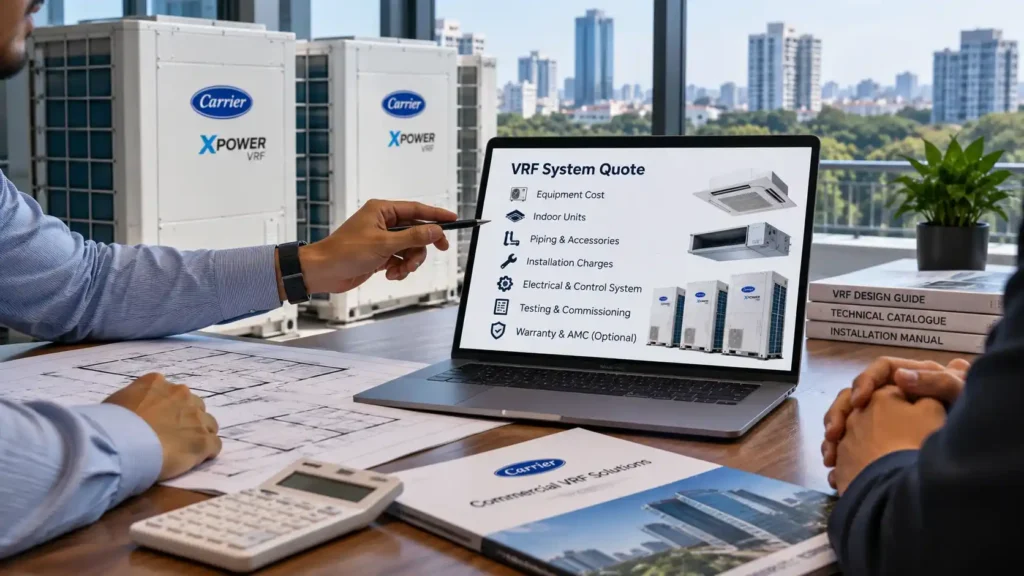
When people search for VRF system cost in Bangalore, they often compare only the equipment price. A proper VRF quote has several parts.
| Quote item | What it covers | Why the cost varies |
|---|---|---|
| Outdoor unit or modules | The shared outdoor system that serves all indoor units | Total capacity and number of modules |
| Indoor units | Units installed in each room or zone | Number of units, type and capacity of each |
| Refrigerant piping | Main pipes, branch joints and insulation | Pipe length, routing and building height |
| Drain piping | Condensate drain lines from indoor units | Number of units and drain routes available |
| Electrical work | Power supply, cabling and protection | Distance from the panel and total load |
| Controls | Individual controllers or central control | Number of zones and level of monitoring |
| Design and engineering | Load calculation, layout and piping design | Size and complexity of the building |
| Installation and commissioning | Fitting, testing and handover | Project size and site access |
| Service plan (optional) | Maintenance or AMC | Number of units and visit frequency |
Equipment Cost
This covers the outdoor modules and the indoor units. It grows with the total capacity and the number of rooms you need to serve. Different indoor unit types have different prices, so the mix you choose affects the total.
Design and Engineering
A VRF system needs a proper design: load calculation for each zone, indoor unit selection, piping layout and outdoor placement. Good design work costs time, but it prevents problems that are expensive to fix after installation.
Installation and Commissioning
Installing a VRF system takes more planning than fitting a few split units. The refrigerant piping network is connected, tested and charged, and the system is commissioned. Both Toshiba and Carrier provide tools for this stage. Toshiba lists Wave Tool technology for commissioning and diagnostics with its SMMS system, and Carrier lists an automatic refrigerant charging feature and the Doctor 2.0 maintenance tool with its XPower system.
Factors That Decide VRF System Cost in Bangalore
Now let us go through each factor. Understanding these helps you read a quote with confidence.
Total System Capacity
The bigger the cooling requirement, the larger the outdoor system. The Toshiba SMMS VRF System goes up to 22 HP on a single module and up to 60 HP when interconnected. The Carrier XPower VRF covers a range of 8 to 246 kW. Your capacity should come from a proper load calculation, not from a thumb rule.
Number and Type of Indoor Units
Every room or zone needs an indoor unit, and each unit adds to the cost. The Toshiba SMMS system supports up to 64 connected indoor units, and both systems offer multiple indoor unit options. A building with many small rooms will usually need more indoor units than an open floor of the same size. If your plan includes ceiling cassette units, our guide on cassette AC installation cost in Bangalore explains what affects that part of the budget.
Building Layout and Number of Floors
A compact single-floor office is simpler than a multi-floor building. More floors mean longer piping, more branch connections and more coordination between trades. The layout of shafts and ceilings also affects how easily pipes can be routed.
Piping Length and Layout
The refrigerant piping network is a major part of VRF installation. Longer runs need more pipe, insulation and labour. VRF systems are designed to support flexible and long piping configurations, but the supplier still needs to check the permitted lengths for the model you choose.
Controls and Monitoring
You can control indoor units individually, or add central control and monitoring across the whole building. More advanced control setups add to the cost but give facility managers a clearer picture of the system. Decide early how much control you need.
Ceiling, Ducting and Indoor Finishing
Concealed or ceiling-mounted indoor units need ceiling work, and ducted units need duct design. If your ceiling needs repair, support or extra finishing, that adds to the project cost.
Outdoor Unit Space and Lifting Access
Outdoor modules are large and heavy. Where they will sit, how they will reach the terrace or plant area, and whether lifting equipment is needed all affect the cost. Check building rules and access early, especially in commercial complexes and tech parks.
Electrical Load and Power Supply
A VRF system needs a dependable power supply. If your panel has no spare capacity, or the cable run is long, extra electrical work may be needed. This is often forgotten during budgeting.
Brand and Model
Different brands and models carry different price points and different feature sets. Compare specifications, support and service availability instead of choosing on brand name alone. C3 Air Solution works with Toshiba and Carrier, and you can browse both ranges on the products page.
Project Timeline and Phasing
Some buildings install the full system at once, while others do it in phases. Phasing can spread the spend, but it needs planning so that the outdoor capacity and piping can support future additions.
VRF vs Split AC Cost: How to Compare Fairly
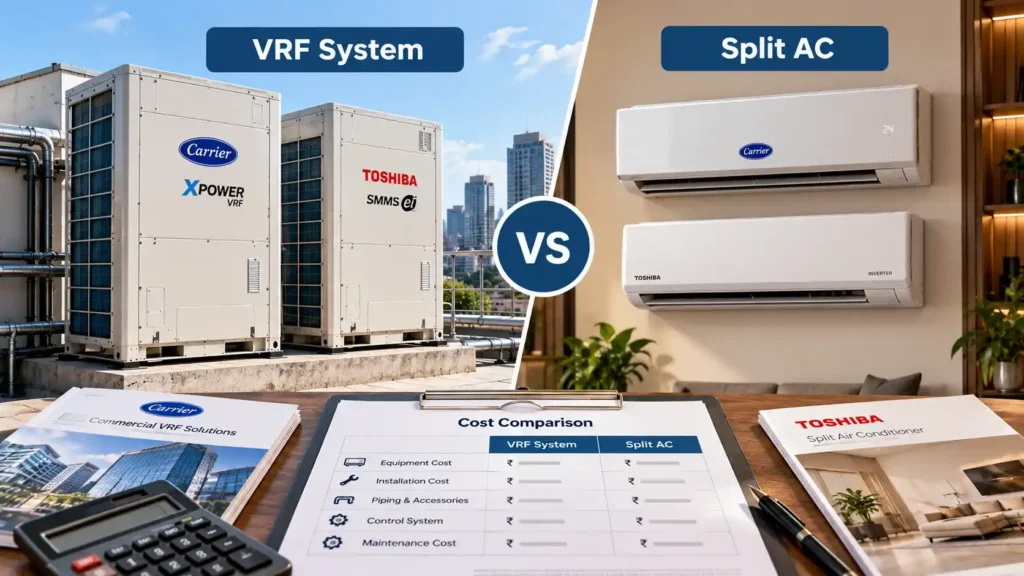
A common mistake when looking at VRF system cost in Bangalore is to compare the price of one split AC with the price of a VRF system. That comparison tells you very little. The right comparison is the total installed cost to cool the same rooms.
| Cost area | Split AC setup | VRF setup |
|---|---|---|
| Outdoor units | One for each indoor unit, so many in a large office | Fewer outdoor units for the same number of rooms |
| Piping | Short runs for each unit | A connected network that needs careful design |
| Design work | Light | More detailed |
| Upfront cost | Usually lower for small offices | Usually higher, but the gap can narrow as rooms increase |
| Control | Separate for each unit | Zone control through one system |
| Servicing | Independent units | System-level maintenance plan |
For a small office, split ACs are often the more economical choice. As the number of rooms and floors grows, VRF becomes more competitive. Our detailed guide on VRF vs split AC for office walks through when each option makes sense.
Cost Drivers at a Glance
This table shows how common project conditions tend to affect VRF system cost in Bangalore.
| Factor | Tends to raise the cost | Tends to keep the cost lower |
|---|---|---|
| Capacity | Large total load | Smaller, well-sized load |
| Indoor units | Many small rooms with separate units | Fewer units serving open areas |
| Floors | Multi-floor building with long piping | Single floor or compact layout |
| Piping | Long, complex routes | Short, direct routes |
| Controls | Central control and detailed monitoring | Basic individual controllers |
| Site | Difficult access or crane needed | Easy terrace or ground access |
| Electrical | New supply or panel upgrade required | Existing capacity is enough |
| Scope | Includes AMC and extras | Supply and installation only |
Hidden Costs Buyers Often Miss
Here are the items that surprise people most often when they budget for VRF system cost in Bangalore:
- Extra piping length beyond what the first quote assumed
- Ceiling repair or finishing after indoor units are fitted
- Drain lines and drain pumps
- Electrical upgrades, cabling and protection devices
- Lifting equipment for outdoor modules
- Central controllers or monitoring add-ons
- Design changes after the building layout is revised
- Servicing after the warranty period
None of these are unusual. They become a problem only when they are left out of the quote and appear later as extras.
Long-Term Cost: Running, Servicing and Expansion
The price you pay on day one is only part of the story. A VRF system will run for years, so look at the long-term picture too.
Energy Use
Both the Toshiba SMMS and Carrier XPower systems use inverter technology, which lets the system adjust its output to match demand. Actual energy use depends on the model, your building and how you use the system. Ask your supplier to explain the efficiency details of the specific model, and avoid anyone who promises exact savings without seeing your building.
Maintenance and AMC
A VRF system works as one network, so servicing is done at system level. Regular maintenance helps the system perform as designed and catches small issues early. If you are planning a service plan, our guide on commercial AC AMC in Bangalore explains what to check before you sign.
Future Expansion
If you may add rooms or floors later, tell your supplier now. A system designed with some room to grow can be extended more easily than one that is sized only for today.
How to Compare VRF Quotes Fairly
Two VRF quotes can look very different even for the same building. When you compare VRF system cost in Bangalore offers, here is how to do it properly.
Ask for an Itemised Quote
A single lump sum hides what you are paying for. Ask for a breakdown that lists outdoor modules, indoor units, piping, controls, electrical work, design, installation and commissioning.
Check the Design Basis
Ask what capacity and zone layout each quote is based on. If one supplier has designed for a much smaller load than another, the lower price may not give you the cooling you need.
Compare the Indoor Unit List
Check the number, type and capacity of indoor units in each quote. A lower quote may simply have fewer or smaller units.
Look at What Is Excluded
Read the exclusions carefully. Items such as ceiling work, electrical upgrades or lifting are often listed as extras.
Ask About After-Sales Support
Find out who handles servicing, how quickly they respond and what maintenance plan is available. A VRF system is a long-term investment, so support matters as much as the purchase price.
How to Plan Your VRF Budget
You do not need to overspend to get a good VRF installation. These steps help you keep VRF system cost in Bangalore under control:
- Start with a layout review. Share your floor plan so the supplier can design the system properly.
- Get the capacity calculated. Do not rely on rules of thumb.
- Decide your control needs early. Choose between individual and central control before quotes are prepared.
- Check site access. Confirm outdoor unit placement and lifting access with building management.
- Ask for the full scope. Include design, commissioning, testing and any service plan.
- Plan for growth. Tell the supplier if you expect to add rooms or floors.
If you are still choosing between system types, read our guide on how to choose AC for office.
Is a VRF System Worth the Cost for Your Building?

VRF system cost in Bangalore matters, but fit matters more. A VRF system makes sense when you have many zones, multiple floors, limited space for outdoor units or plans to expand. It allows different indoor areas to be managed through one coordinated system. For a small office with a handful of rooms, individual units may be simpler and more economical.
The best way to decide is to look at your layout, your usage and your growth plans together, and then compare complete quotes for both options.
How C3 Air Solution Can Help
C3 Air Solution LLP works with Toshiba and Carrier and offers system selection support, site inspection where applicable, installation, commissioning, testing, maintenance and after-sales support. If you want a realistic VRF system cost in Bangalore for your building, share your floor plan, number of rooms and usage with the team. They can help you shortlist a suitable VRF system and prepare a quote based on your actual site.
You can send your requirements through the Get a Quote page, or call +91 9000811099.
Final Thoughts
VRF system cost in Bangalore is not one number. It is the combined cost of equipment, design, piping, controls, installation and the support that follows. The more clearly you understand each part, the easier it is to compare quotes and avoid surprises later.
If you would like a quote that reflects your real building and layout, share your requirements with the C3 Air Solution team through the contact page.
FAQs: VRF System Cost in Bangalore
What is the VRF system cost in Bangalore?
It depends on the total capacity, the number and type of indoor units, the building layout, the piping design and the controls you choose. Because every building is different, the only reliable figure comes from a quote based on a layout review or site visit.
Why is VRF usually costlier than split AC at the start?
A VRF system involves more design work, a refrigerant piping network and shared outdoor modules, so the upfront cost is usually higher for small spaces. As the number of rooms and floors grows, the comparison becomes closer. Compare full installed quotes instead of unit prices.
Does the number of indoor units affect the cost?
Yes. Each indoor unit adds to the equipment, piping and installation cost. The Toshiba SMMS system supports up to 64 connected indoor units, but the right number for your building depends on your layout and design.
Is a per-square-foot rate reliable for VRF?
Not really. A per-square-foot or per-tonne figure ignores your layout, piping length, floors, controls and site conditions. Use it only as a rough starting point and rely on a proper quote.
Are there extra charges after a VRF quote?
There can be if the quote is not itemised. Common extras include additional piping, ceiling work, electrical upgrades, lifting equipment and controllers. Ask for them to be included in the original scope.
How much does VRF servicing add to the cost?
It depends on the number of units, the system size and the service plan. Ask for a maintenance or AMC quote along with the installation quote so you can see the full picture.
Can C3 Air Solution give a quote for a VRF system?
Yes. You can use the Get a Quote page or call +91 9000811099. Share your building details so the team can suggest a suitable Toshiba or Carrier VRF option.