
How to choose AC for office use sounds simple until you start comparing options. Split, cassette, ducted, floor standing and VRF systems all promise to cool a room, yet they suit very different layouts, budgets and buildings. A wrong pick can mean uneven cooling, noisy rooms, a crowded outdoor area or a system that cannot grow with your team.
This guide walks you through the decision in seven practical steps. It is written for office owners, admin heads and facility managers in Bangalore who want a clear way to shortlist the right system before they speak to suppliers.
How to Choose AC for Office: The Short Version
If you only have a minute, this is the whole process:
- Map your office layout and how each space is used.
- Understand the main types of office AC.
- Get the capacity right.
- Decide between inverter and non-inverter models.
- Check your building and installation conditions.
- Look at running costs and maintenance.
- Compare suppliers on support, not just price.
The rest of this guide explains each step in plain language, with examples from the Toshiba and Carrier range at C3 Air Solution.
Step 1: Start With Your Office Layout
Anyone working out how to choose AC for office space should look at the floor plan before a single AC model. Most bad AC decisions begin with a skipped layout review.
Count the Rooms and Zones, Not Just the Floor Area
An office of the same total size can need very different systems. One open hall is easy to cool with a few evenly placed units. The same area divided into ten cabins, two meeting rooms and a server corner is a different job. Note how many separate zones you have, because each one may need its own control.
Note What Each Space Is Used For
A reception, a conference room and a cabin used by one person do not have the same cooling needs. Write down how many people use each space, how long it stays occupied and how much equipment runs inside it. Rooms full of computers and people need more cooling than a storage area, even when both are the same size.
Step 2: Understand the Main Types of Office AC
A big part of how to choose AC for office use is knowing what each system does well. There is no single best AC for every office. There are five common types, and each one has a natural fit. Here is a quick comparison before we go through them one by one.
| AC type | How it works | Often considered for | In the C3 range |
|---|---|---|---|
| Hi-wall split | Wall-mounted indoor unit with a separate outdoor unit | Cabins and small rooms | Carrier Hi-Wall / Split AC, Toshiba Shibui Hi-Wall Series, Toshiba Hi-Wall Classic Series |
| 4-way cassette | Ceiling-mounted unit that spreads air in four directions | Open areas and mid-size rooms | Carrier 4-Way Cassette AC, Toshiba 4-Way Cassette AC |
| 1-way cassette | Slim ceiling unit with one-way airflow | Small and medium spaces | Carrier 1-Way Inverter Cassette AC |
| Ducted | Concealed unit that delivers air through ducts | Larger spaces where a clean ceiling look matters | Carrier Ducted AC, Carrier Inverter Ducted AC |
| Floor standing | Tall standalone unit placed on the floor | Larger rooms and halls | Carrier Floor Standing AC |
| VRF | One shared outdoor system serving many indoor units | Multi-zone and multi-floor offices | Toshiba SMMS VRF System, Carrier XPower VRF |
Hi-Wall Split AC

This is the familiar wall-mounted unit. It works well for individual cabins and small rooms because each unit is independent. If one needs service, the others keep running. The Carrier Hi-Wall / Split AC and both Toshiba hi-wall series are made for residential and commercial spaces.
Cassette AC
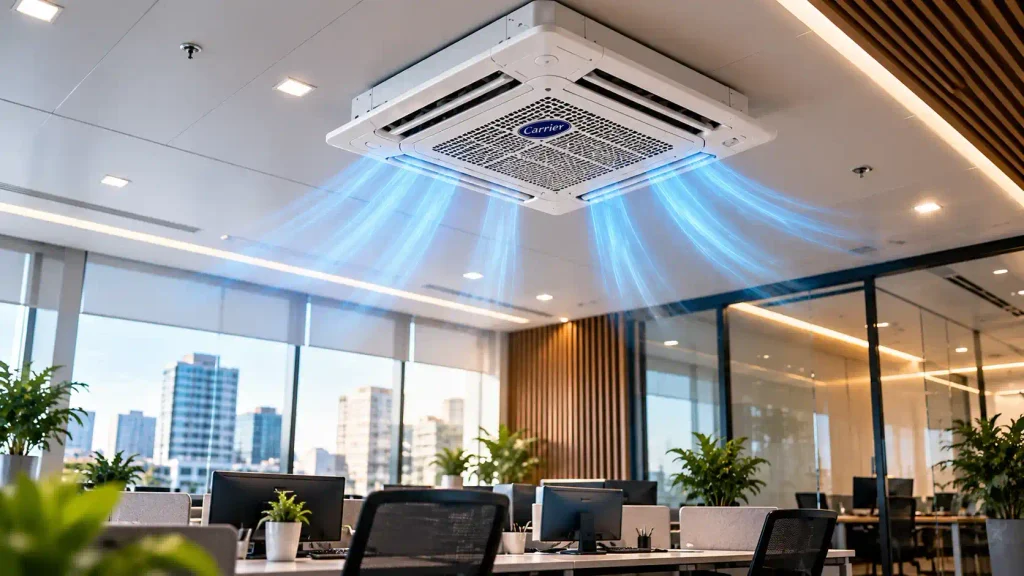
Cassette units sit inside the ceiling, so they free up wall space and keep the room looking clean. The Carrier 4-Way Cassette AC spreads air in four directions for more even cooling and is listed in a 2 to 6 HP range. The product details describe it as suitable for light commercial spaces such as offices, retail stores and hotels. If you want something slimmer, the Carrier 1-Way Inverter Cassette AC has a 132 mm indoor unit height and is designed for small and medium spaces.
Ducted AC
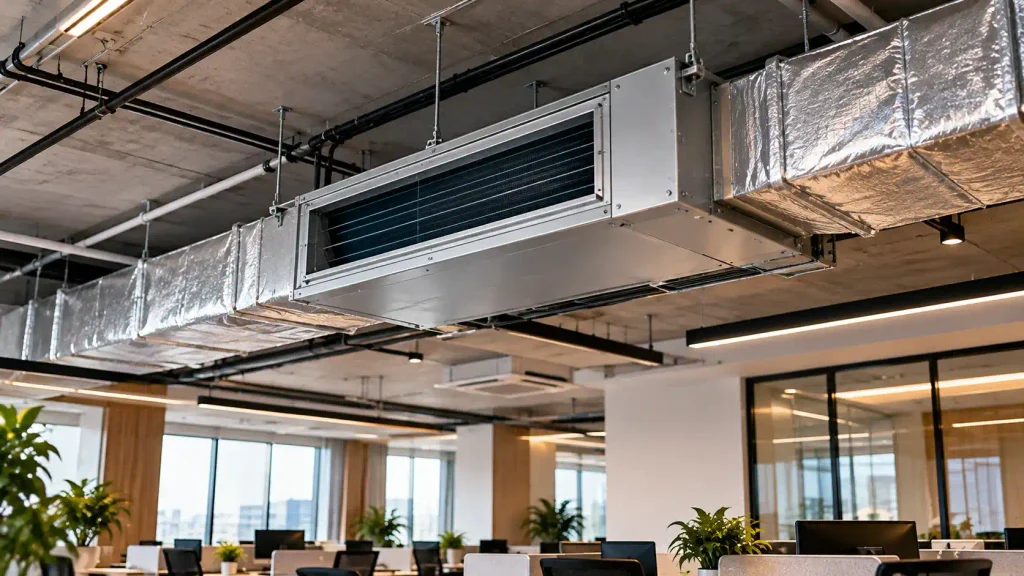
A ducted system hides the indoor unit above the ceiling and delivers air through ducts. It suits larger spaces where you want even cooling without visible units. The Carrier Ducted AC is listed from 10.6 to 59.8 kW, and the Carrier Inverter Ducted AC is shown in 7, 11, 14 and 22 HP options. Ducted systems need space above the ceiling and a planned duct layout, so they need more upfront design.
Floor Standing AC

A floor standing unit does not need ceiling installation, which helps where the ceiling cannot take a cassette or ducted unit. The Carrier Floor Standing AC is listed at 7 to 13.5 kW and is designed for larger indoor spaces where high-capacity cooling is needed.
VRF Systems
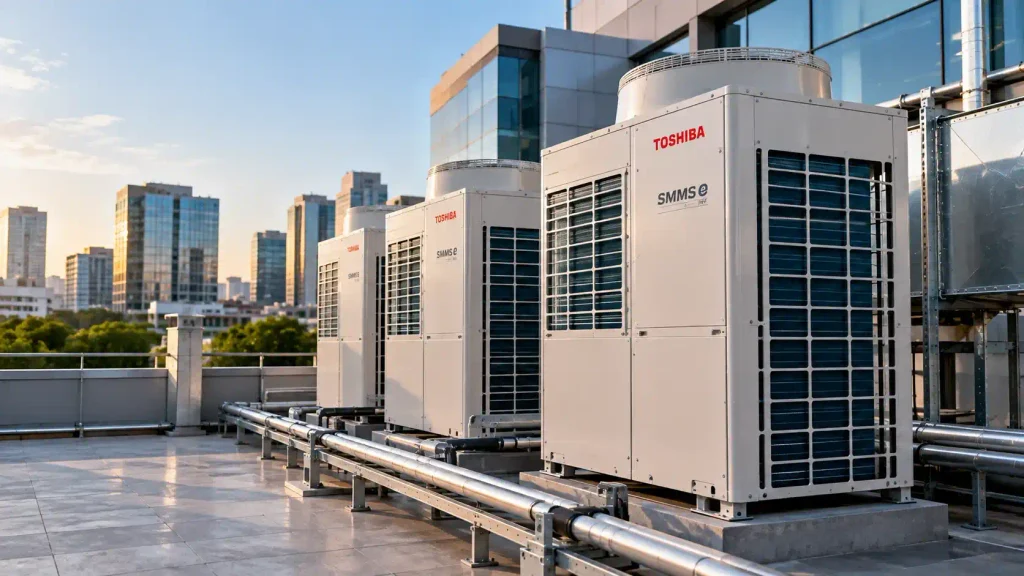
VRF connects many indoor units to a shared outdoor system and gives zone-by-zone control. The Toshiba SMMS VRF System goes up to 22 HP on a single module, up to 60 HP when interconnected, and supports up to 64 connected indoor units. The Carrier XPower VRF covers 8 to 246 kW. If you are deciding between VRF and individual units, our detailed guide on VRF vs split AC for office covers that choice in depth.
Step 3: Get the Capacity Right
When people ask how to choose AC for office use, capacity is where most of the mistakes happen. They either overspend or end up with a room that never feels cool enough.
Why Bigger Is Not Always Better
An oversized AC cools the room quickly, switches off, and then switches on again and again. That can leave the room uncomfortable and humid. An undersized AC runs flat out and still struggles. Both situations waste money and comfort.
What Decides the Right Capacity
The right size depends on more than floor area. These factors matter:
- Number of people in the space
- Computers, printers and other equipment
- Lighting
- Sunlight and glass walls
- Ceiling height
- Which floor you are on, and what is above you
- Doors that open often, such as a reception
Capacity is quoted in different units, so do not get confused. The C3 product pages use HP and kW, and you may also hear TR (tonnes of refrigeration). One TR is roughly 3.5 kW of cooling. Rather than trusting a thumb rule from a friend, ask for a proper load calculation or a site visit.
Step 4: Decide Between Inverter and Non-Inverter
Another part of how to choose AC for office needs is the inverter question. An inverter AC adjusts its output to match demand instead of constantly switching fully on and off. The Carrier 1-Way Inverter Cassette AC and the VRF systems from both brands use inverter technology for this reason.
A non-inverter model runs at a fixed speed. The Carrier Non-Inverter Cassette AC is described as a fixed-speed, ceiling-mounted solution for practical and distributed air conditioning in commercial spaces. You can see it on the Carrier Non-Inverter Cassette AC page.
Which one fits your office? Inverter models are generally a sensible match when the AC runs for long hours every day. A fixed-speed model may suit tighter upfront budgets or spaces used lightly. Because costs and savings vary by model, ask your supplier to explain the figures for the specific unit you are considering.
Step 5: Check Your Building and Installation Conditions
This step is where Bangalore offices often get surprised. Even a careful approach to how to choose AC for office needs can fail on building limits, because a good system on paper can still be hard to install in the wrong building.
Outdoor Unit Space and Permissions
Count how many outdoor units your plan needs and where they will sit. Many commercial buildings and tech parks have rules about terrace, facade and shaft use. Speak to building management before you finalise anything.
Ceiling Height and False Ceiling
Cassette and ducted indoor units need space above the ceiling. Measure the available height before you choose a type.
Drainage and Piping
Condensate water has to drain somewhere. Some cassette models include a built-in drain pump, which helps when drain routing is awkward. The Carrier 4-Way Cassette AC lists a built-in high-lift drain pump. Piping length between indoor and outdoor units also matters, especially on multi-floor layouts.
Power and Electrical Capacity
Check that your electrical supply can handle the new load. This is easy to forget and expensive to fix later.
Step 6: Think About Running Costs and Maintenance
The price you pay on day one is only part of the cost of an AC. Electricity use, servicing and repairs add up over the years.
Look at the efficiency details of each model, including star ratings where they apply. For example, the Carrier 1-Way Inverter Cassette AC and the Carrier Floor Standing AC list a 3-Star BEE rating on their product pages. Ratings differ by model, so check the exact unit.
Also ask who will service the system and how quickly. For larger offices, an annual maintenance contract (AMC) keeps servicing planned instead of reactive.
Step 7: Compare Suppliers on Support, Not Just Price
Supplier support is part of how to choose AC for office projects properly. Two quotes for the same AC can look very different once you read the scope. Before you decide, ask each supplier:
- Will you visit the site before recommending a system?
- What exactly is included: supply, installation, commissioning, testing?
- What after-sales support and service options are available?
- Can you explain why you picked this system for my layout?
- Which brand and model are you proposing, and can I see the catalogue details?
A supplier who asks you about your layout, usage and growth plans is usually thinking about your office. One who quotes a number in two minutes is usually thinking about the sale.
Which AC for Which Office? A Quick Guide
These are common starting points, not final answers. Your layout and building will always change the picture.
| Office type | Common starting point | Things to check |
|---|---|---|
| Small office with a few cabins | Hi-wall split ACs | Outdoor unit locations, individual control |
| Open-plan office or workspace | 4-way or 1-way cassette ACs | Ceiling height, false ceiling, drainage |
| Large floor with a clean-ceiling look | Ducted AC | Duct layout, space above the ceiling |
| Reception, hall or large room | Floor standing AC | Floor space, airflow direction |
| Multi-zone or multi-floor office | VRF system | Outdoor space, piping design, maintenance plan |
Common Mistakes When Choosing an Office AC
Most errors in how to choose AC for office projects repeat themselves:
- Choosing by price alone. The cheapest quote can cost more in energy, repairs and discomfort.
- Guessing the capacity. Rules of thumb ignore sunlight, equipment and occupancy.
- Ignoring the building. Outdoor space, permissions and ceiling height can rule out options late in the process.
- Skipping maintenance planning. A neglected system loses performance sooner than you expect.
- Not planning for growth. If you will add desks or rooms, tell your supplier now.
How C3 Air Solution Can Help
C3 Air Solution LLP works with Toshiba and Carrier and offers system selection support, site inspection where applicable, installation, commissioning, maintenance and after-sales support. If you are still working out how to choose AC for office needs, share your layout, number of rooms and usage with the team, and they can help you shortlist suitable options from the full product range.
You can send your requirements through the Get a Quote page, or call +91 9000811099.
Final Thoughts
Knowing how to choose AC for office spaces comes down to a clear order of decisions: layout first, then type, capacity, efficiency, building conditions, maintenance and supplier. Skip a step and the problem usually shows up after installation, when it is harder and costlier to fix.
If you would like help comparing options for your office in Bangalore, share your requirements with the C3 Air Solution team through the contact page.
FAQs:
How do I choose the right AC for my office?
Start with your layout and the number of separate zones. Then match the AC type to those zones, get the capacity checked through a load calculation, and confirm that your building can handle the installation. Comparing suppliers on support as well as price completes the process.
Which type of AC is best for an office?
There is no single best type. Hi-wall splits suit cabins and small rooms, cassette units suit open areas, ducted systems suit larger spaces with a clean ceiling look, and VRF suits multi-zone or multi-floor offices.
How do I know what AC capacity my office needs?
Capacity depends on floor area, number of people, equipment, sunlight, ceiling height and how the space is used. A site visit or load calculation is the safest way. Avoid relying on a thumb rule alone.
Is an inverter AC better for office use?
Inverter models adjust their output to match demand, which makes them a sensible fit for spaces that run for long hours. Fixed-speed models can suit lighter use or tighter upfront budgets. Ask for model-specific details before you decide.
When should an office choose a VRF system?
VRF is usually worth considering for larger offices with many zones, multiple floors or plans to expand. For a small office with a few rooms, individual units are often simpler. Our guide on VRF vs split AC for office explains the difference in detail.
Do I need a site visit before buying an office AC?
It is strongly recommended. A visit lets the supplier check layout, ceiling height, outdoor unit locations and electrical points before suggesting a system. C3 Air Solution offers site inspection where applicable.
How can I get a quote from C3 Air Solution?
Use the Get a Quote page or call +91 9000811099. Share your office layout, the number of rooms and any growth plans so the team can suggest suitable Toshiba and Carrier options.
Pingback: Cassette AC Installation Cost in Bangalore: Price Factors