
VRF vs split AC for office is one of the first decisions you need to sort out when you plan a new workspace. Both systems cool the same rooms, but they work differently, cost differently and suit different buildings. Pick the wrong one and you may end up with a crowded outdoor area, uneven cooling or a setup that is hard to expand later.
This guide explains both options in plain language. You will see where each one fits, what to check in a Bangalore office building, and how to decide without guessing. Read it before you speak to any supplier, including us.
VRF vs Split AC for Office: The Quick Answer
If your office is small, on one floor and has only a few rooms, split ACs are usually the simpler and more affordable route. If your office is large, spread across several zones or floors, or likely to grow, a VRF system is usually the better long-term fit.
That is the short version. The rest of this blog explains why, and where the grey area sits in between.
What Is a Split AC in an Office?

A split AC has two parts: an indoor unit inside the room and an outdoor unit placed outside the building. Each indoor unit is paired with its own outdoor unit, and every pair works on its own.
In offices, this usually means wall-mounted units in cabins and meeting rooms. C3’s range includes the Carrier Hi-Wall / Split AC, the Toshiba Shibui Hi-Wall Series and the Toshiba Hi-Wall Classic Series. For open areas, ceiling-mounted cassette units such as the Carrier 4-Way Cassette AC are another common choice.
The biggest advantage is simplicity. Every unit runs independently, so if one needs service, the rest keep working. The trade-off is that each indoor unit brings an outdoor unit with it, and in a bigger office that adds up quickly.
What Is a VRF System?
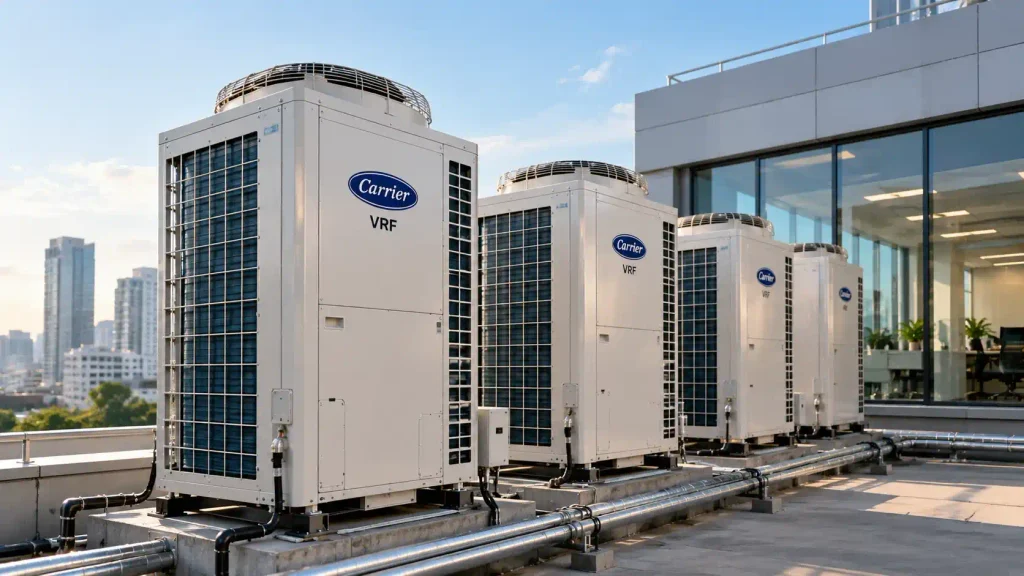
VRF stands for Variable Refrigerant Flow. Instead of one outdoor unit for every indoor unit, a VRF system connects many indoor units to a shared outdoor system through a network of refrigerant pipes. The system adjusts how much refrigerant goes to each indoor unit, based on what that space needs at the time.
In practice, this gives you zone-by-zone control. A busy open workspace can be cooled properly while an empty meeting room stays on a lighter setting or off, all from one coordinated system.
Two VRF options in C3’s range are worth a look:
- The Toshiba SMMS VRF System is designed for larger buildings and multi-zone use. A single module goes up to 22 HP, an interconnected system goes up to 60 HP, and it supports up to 64 connected indoor units.
- The Carrier XPower VRF uses full DC inverter technology and covers a capacity range of 8 to 246 kW. It supports long piping configurations and includes a sensor backup system.
How the Two Systems Behave Day to Day
Specifications only tell you so much. What matters is how each system feels to use once the office is running.
With split ACs, a person in a cabin controls their own unit with a remote. That is easy to understand, but it also means ten rooms can have ten different settings, and nobody has a full picture. In a small office this is fine. In a larger one, it can lead to rooms being cooled when nobody is there.
With a VRF system, the indoor units can still be set room by room, but they sit on one network. Many VRF systems offer central controllers or monitoring options, so an office manager can see and manage the whole setup from one place. Carrier, for example, lists system monitoring tools with XPower VRF, and Toshiba offers Wave Tool for commissioning and diagnostics with SMMS-e.
Both Toshiba SMMS-e and Carrier XPower use inverter technology, which means the system can adjust its output to match demand instead of simply switching on and off. If you are comparing running costs, ask for details of the specific model and how it suits your usage, rather than relying on general claims.
VRF vs Split AC for Office: Side-by-Side Comparison
| Factor | Split AC | VRF system |
|---|---|---|
| Setup | One outdoor unit for each indoor unit | Many indoor units on a shared outdoor system |
| Outdoor space | Needs room for many outdoor units in a large office | Needs far fewer outdoor units for the same number of rooms |
| Zone control | Each unit is controlled separately | Zone-wise control through one system |
| Upfront cost | Usually lower for small offices | Usually higher, though the gap can narrow as rooms increase |
| Planning | Simple and quick | Needs proper piping and layout design |
| Expansion | Add another unit when needed | Add indoor units within the system’s capacity |
| Servicing | One unit is independent of the others | System-wide, so a planned maintenance routine matters |
| Best for | Small offices with a few rooms | Large, multi-zone or multi-floor offices |
When a Split AC Is the Better Choice
In the VRF vs split AC for office decision, split ACs win in a few clear situations. A split AC makes more sense when:
- Your office is small, with only a handful of rooms or cabins.
- You want the lowest upfront spend and a quick installation.
- Only one or two areas need cooling.
- Your lease is short and you do not want a larger fixed installation.
- You are happy with each room being controlled separately.
For a compact office, a VRF system can be more than you need. There is no point paying for a larger system that your space will never use.
When VRF Makes More Sense
For a bigger workspace, the VRF vs split AC for office question often tips towards VRF. It starts to make sense when:
- The office has many rooms or zones, such as cabins, conference rooms and open desks.
- It spans multiple floors or a large floor area.
- Space for outdoor units is limited, so fewer outdoor units is a real advantage.
- You expect to add rooms or teams in the next few years.
- You want central control across the whole office.
- You want a cleaner look from outside with fewer outdoor units.
Three Office Examples
Real offices do not fit neatly into a category. Here are three simple examples of how the VRF vs split AC for office choice can play out.
A Small Consulting Office With Two Cabins and One Open Area
There are very few zones and the layout is simple. Wall-mounted split units, with maybe one cassette in the open area, usually do the job without any extra complexity.
A Growing IT Team on One Full Floor
Here the office has a mix of cabins, meeting rooms and open desks. The number of indoor units rises quickly and outdoor space becomes the real question. This is the grey area where it is worth comparing both options on paper with an actual layout.
A Multi-Floor Corporate Office With Many Rooms
This is where VRF usually pays off. One outdoor system serving many indoor units, with zone control, is easier to manage than a long row of separate outdoor units.
These are examples, not rules. The right answer always depends on your building and plan.
Things to Check Before You Decide
This is where most of the real VRF vs split AC for office decision happens. Go through these points before you finalise anything.
Outdoor Space
Count how many outdoor units your plan needs and where they will sit. In many Bangalore commercial buildings, terrace and facade space is shared or restricted, so check with building management early.
Building Rules and Permissions
Some buildings and tech parks have rules about where outdoor units and pipes can go. Find this out before you buy anything.
Office Layout
Open floors, enclosed cabins and meeting rooms all have different cooling needs. A rough floor plan helps a great deal.
Ceiling and False Ceiling
Cassette and ducted indoor units need space above the ceiling. Check the height available.
Future Growth
If you may add desks or rooms, plan for it now. Expanding later is easier when the system was designed with room to grow.
Maintenance
Ask who will service the system and how often. A service plan or AMC is worth considering, especially for larger systems.
A Simple 5-Question Check
Stuck on VRF vs split AC for office? Answer these honestly and you will usually know which way to lean:
- How many separate rooms or zones need cooling?
- Is the office on one floor or several?
- Where can the outdoor units go?
- Will the office grow in the next two or three years?
- Are you deciding on upfront cost only, or on the full picture over several years?
If your answers are mostly “few, one, easy, no, upfront”, a split AC setup is likely to serve you well. If they lean towards “many, several, limited, yes, full picture”, look seriously at VRF. If the answers are mixed, that is the time to get a proper layout review instead of guessing.
Common Mistakes to Avoid
Most problems with VRF vs split AC for office decisions come from a few repeat mistakes:
- Choosing on price alone. The cheapest option on day one is not always the easiest one to live with.
- Ignoring outdoor space. Many units on a small terrace is a problem you can avoid by planning.
- Skipping the layout study. Capacity decisions made without looking at the actual space often lead to hot spots.
- Mixing systems without a plan. Adding random units over time can make an office harder to manage.
- Forgetting maintenance. Any system performs better with regular servicing.
How C3 Air Solution Can Help
C3 Air Solution LLP works with Toshiba and Carrier and offers system selection support, site inspection where applicable, installation, commissioning, maintenance and after-sales support. If you are stuck on VRF vs split AC for office use in Bangalore, tell the team about your space, number of rooms and growth plans. They can help you shortlist suitable options from the Toshiba and Carrier range, including ducted AC and cassette systems if your layout calls for them.
You can send your requirements through the Get a Quote page, or call +91 9000811099.
Final Thoughts
There is no single winner in the VRF vs split AC for office debate. Small, simple spaces usually do well with split ACs. Larger, multi-zone offices, or those that are likely to grow, often benefit from a VRF system. The right choice depends on your layout, outdoor space, building rules and long-term plans.
If you would like help comparing options for your office in Bangalore, share your requirements with the C3 Air Solution team through the contact page.
FAQs:
Is VRF better than split AC for an office?
Not always. VRF is usually better for large, multi-zone or multi-floor offices. For a small office with a few rooms, split ACs are often simpler and more practical.
Is a VRF system more expensive than split AC?
Upfront, VRF is usually higher. The difference depends on your layout, number of rooms and system size, so the right way to compare is to request quotes based on your actual floor plan.
Can a small office use a VRF system?
Yes, it is possible, but it is often more than a small office needs. If you have two or three rooms, split ACs are usually the simpler choice.
How many indoor units can connect to the Toshiba SMMS-e VRF System?
According to the product details, it supports up to 64 connected indoor units. The number that suits your office depends on your layout and system design.
Does VRF need special space or planning?
Yes. You need space for the outdoor system, routes for refrigerant piping and ceiling space for indoor units. A proper design before installation matters.
Which one is easier to maintain?
Split units run independently, which keeps things simple. A VRF system is managed as one network, so a regular service plan or AMC is particularly useful.
Which VRF options are available at C3 Air Solution?
You can explore the Toshiba SMMS-e VRF System and the Carrier XPower VRF, along with hi-wall, cassette, ducted and floor standing options from both brands.
Pingback: How to Choose AC for Office in Bangalore: A Simple Guide
Pingback: Cassette AC Installation Cost in Bangalore: Price Factors
Pingback: Commercial AC AMC in Bangalore: Coverage and Checklist
Pingback: VRF System Cost in Bangalore: What Decides the Price